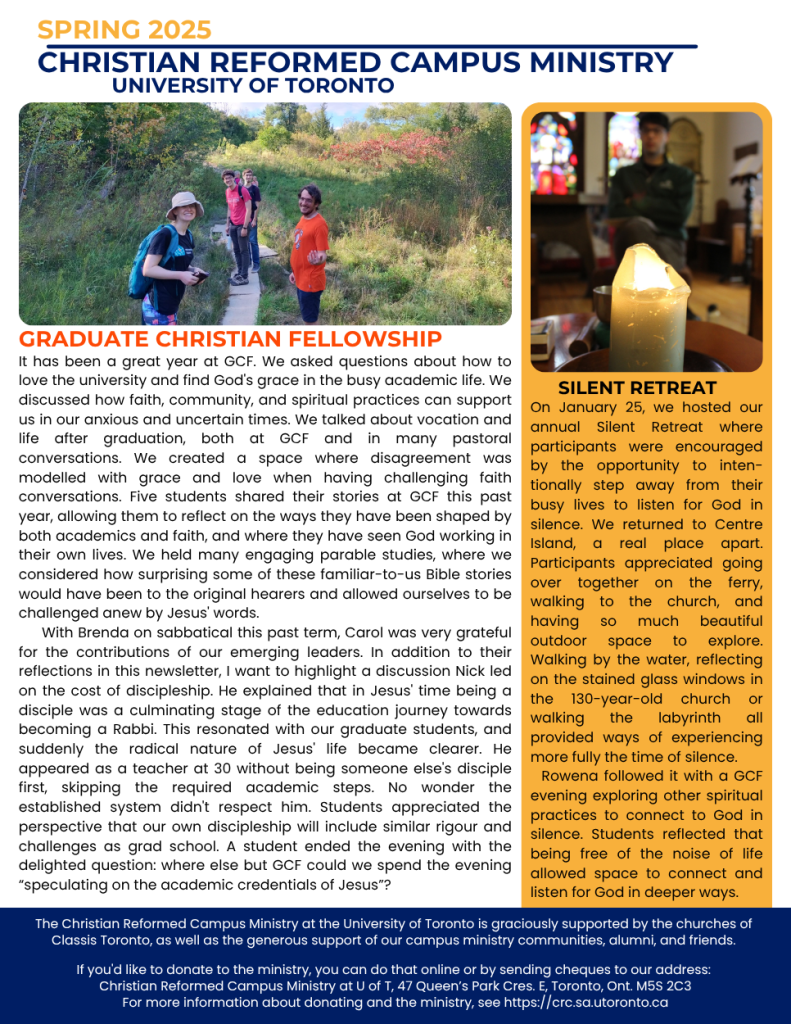
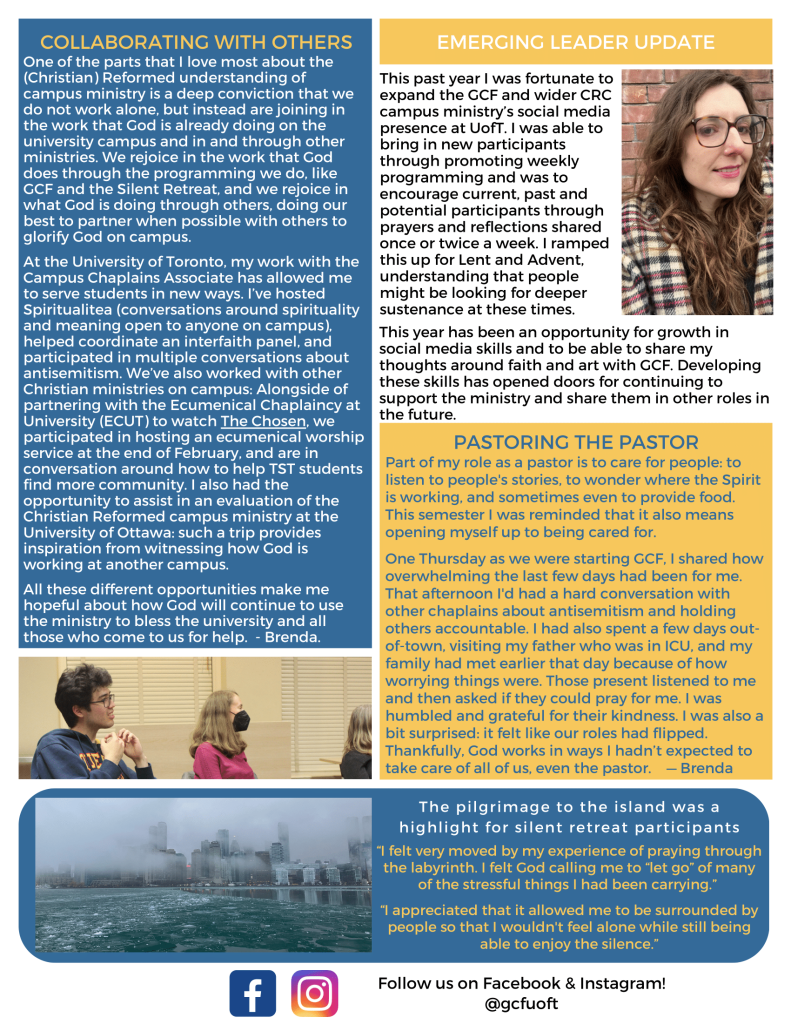
see below or this pdf link for the spring 2026 newsletter for the CRC campus ministries at UofT and YorkU.


see below or this pdf link for the spring 2026 newsletter for the CRC campus ministries at UofT and YorkU.
Tonight we are talking about Sabbath at Graduate Christian Fellowship. As preparation, I glanced through MaryAnn McKibben Dana’s book, Sabbath in the Suburbs. I read the book a number of years ago when I first became a parent and found it deeply encouraging. While I love the idea of Sabbath as being restful and contemplative, the reality is that it’s hard to stop from the pressures and realities of the rest of life (and when you do stop, doing nothing or binging feel like the best activities). And practising Sabbath can be hard, whether you are a parent of a small child or a single person. Dana’s book felt like a gift, a recognition that some things are worth trying to (continue to) do, even if/when we can’t do them at the level we think (or feel pressured) to do.
The following are a number of quotes from the book to provide encouragement and fodder for thought, in the hopes that they help you imagine practising Sabbath in your life:
Some reflections from Dana on her experience:
The Well also provides several helpful reflections on the Sabbath:
As we start our gatherings, we “acknowledge the history, spirituality, culture, and ancestral stewardship of the land on which we regularly meet by the Huron-Wendat, Haudenosaunee and Anishinabek Nations, and the Mississaugas of the New Credit First Nation.” We continue our land acknowledgement with words that one of our emerging leaders helped us adopt several years ago: “we commit ourselves to seeking to live out the Good Way, which encompasses both love and humility as we bravely journey towards the justice which Jesus proclaimed with his words, life, death and resurrection.”
Our land acknowledgement recognizes our complex histories of the land on which we live and gather and reminds us of our desire to learn from other cultures. One way we as a community have chosen to more actively learn from Indigenous wisdom is through using the First Nations Version of the Bible, which is an Indigenous translation of the Bible. Using a different translation of the biblical text can be helpful for hearing the text in a new way; furthermore, the use of cultural norms and words that are different from what many of are used to can challenge our assumptions about what the text means.
As we have been using this version of the Bible at our gatherings these past few years, many people have commented on how the translation uses descriptions for names, such as Creator Sets Free (Jesus), Bitter Tears (Mary), Father of Many Nations (Abraham) and House of Bread (Bethlehem). Such descriptions may feel distracting at times but most of us have found them helpful, as they provide us with extra information for understanding the biblical text, including the meaning of the words in the original language.
Using the First Nations Version of the text is a simple and concrete way of acting out our desire to learn from Indigenous voices. We are hopeful that the Holy Spirit will work in and through this translation to allow many to grow in appreciation of the Bible and how we can learn from other cultures.
This past week we looked at 1 Peter 3 at GCF. The following was the email text send out to GCF folks ahead of time (which was adapted from a Wine Before Breakfast email sent out in summer 2021).
I grew up in a tradition where having the right answer mattered. It was important not to let others live in ignorance if we had the answers or knew they were doing something wrong, even if they didn’t like what we had to say. I thought this was what Christians ought to do, a way to share the truth we had with others.
It took me a long time to realize that this was a poor interpretation of the text. 1 Peter 3:15 highlights that we are not to go around telling people the right answer(s), but instead to wait until we are asked. This implies living in such a way that people will want to ask about our love and humility and why we repay evil with blessing (1 Peter 3:8-9). Assuming that people will be impressed by how we live, we are to be prepared to give people an answer. The text commands us to be prepared to give an answer, not to give an answer. It is as if the preparation is what matters most, as if the answer is more for us than for others.
The answer that we are to prepare is not the ‘this is how you ought to live your life’ kind of answer, but the sort of answer that shares what has happened in our lives so that we have hope. And then, just in case we’ve started leaning towards responding to others with an “I know how to fix your life so it will be better” answer, the text reminds us to give our answers with gentleness and respect.
Having the text challenge our assumptions is one of the things I love most about studying the Bible, especially in community. When I lead a study, I hope that we will all be challenged and am thankful that the Spirit can use the insights and experiences of all those present to challenge us, including myself.
Not surprisingly, the study this week reminder that the word answer (or defense, depending on your translation of the Greek, “apologia“) is necessarily a response to other’s curiosity or questions. It makes me wonder how I can live such a life that people might ask me about the hope I have, or how to give answers to ordinary questions that bear witness to how I sense the Spirit working in my life, even as this might make me uncomfortable.
– Brenda Kronemeijer-Heyink, Chaplain
As a ministry we desire to create spaces where young adults and others connected to the university feel welcome. We especially want to be a safer space to those who might feel less welcome in more traditional church or Christian spaces, such as those who ask uncomfortable questions or who have experienced trauma or other negative experiences related to church.
As part of that desire to be a safer space, we’re working on providing descriptions on our website for what people can expect if they attend gatherings, the opportunity to meet with a chaplain ahead of time, and through having and ensuring we follow our safe campus policy. In our conversations, we encourage and welcome a diverse range of opinions and we also are intentional about (graciously) challenging people to pay attention to how their language might comes across as racist or ableist, as being dismissive of the complexity of the Bible and Christianity, and/or as being exclusive of or causing distress to others.
We do this recognizing
It is our hope that we might learn from the wisdom of people like Benckhuysen and Kuipers and so be safer spaces where people are able to lament injustice as well as imagine and long for God’s kingdom.
It has been a season of transitions and a season of trying new things again. We are thankful for God’s presence with us and how God has been working in and through the ministry.
To view our end-of-year newsletter, follow this link.
It’s that time of year again when we tell the stories of how God is working in and through the ministry. We share stories of hope, as a way of encouraging ourselves and others about how God uses our efforts and our presence on campus and in people’s lives. We also try to acknowledge what has been hard and where we are still waiting. At a recent gathering of regional Christian Reformed campus ministers, people’s sharing about the challenges of this season were especially encouraging. It is helpful to hear that we are not the only group that is discerning how best to reach out to a student population that is exhausted and overwhelmed, looking for community and struggling to connect and commit. It is good, in the middle of those struggles, to both hear and tell of glimpses of hope found in good conversations where there has been a sense of God’s presence: conversations that sometimes happen only once but sometimes continue over time, conversations where learn more of God’s grace and open themselves more fully to the Spirit.
The following story from Richard Mouw is one of those stories that resonated with me as a campus minister: it is a story of being God’s presence to those around us and a story of hope, even as the story feels unfinished, or at least without the clear ‘happy’ ending many of us long for.
Mouw describes a letter he once received from a recent graduate of Fuller:
[She had lost her faith] in her senior year at the evangelical college she attended. It wasn’t the fault of anyone at that school. She had received a good education there and had made many friends. And now also at Fuller—she had learned much, but with the same result—still no recovering of faith.
She had not shared her loss of faith with any family or friends, and she was now thinking about how best to do that. Writing to me was for her a first step. During her senior year of college, having realized that she no longer believed, she decided “to give Fuller a chance” at helping to restore her faith. Nor did she regret that decision. While her faith had not returned, she wrote, “Fuller gave it a good shot!” And then she said something that brought a gasp from me, followed by many tears. She wanted to thank me especially, she said, because, in a philosophy class that I taught, she came close to believing again. “It was in a lecture on Nietzsche. You laid out the issue of a living God versus a dead God, and for a moment—a moment!—I felt like I could believe again. But the feeling went away. But thank you for giving it a try!”
I still shed tears over her words to me. I often pray for her. I think much about what I, or the school that I served as president, should have done differently.”
Mouw continues by reflecting on what it might look like to make space for people asking questions and for people to be honest about how and what they believe. I pray that campus ministries and the wider church might provide that kind of space.